
Last updated September 20, 2026
Free on-site gate assessment - hinges, posts, and your LiftMaster or Nice gate operator checked before anything is quoted
The assessment is free and the quote is the invoice.
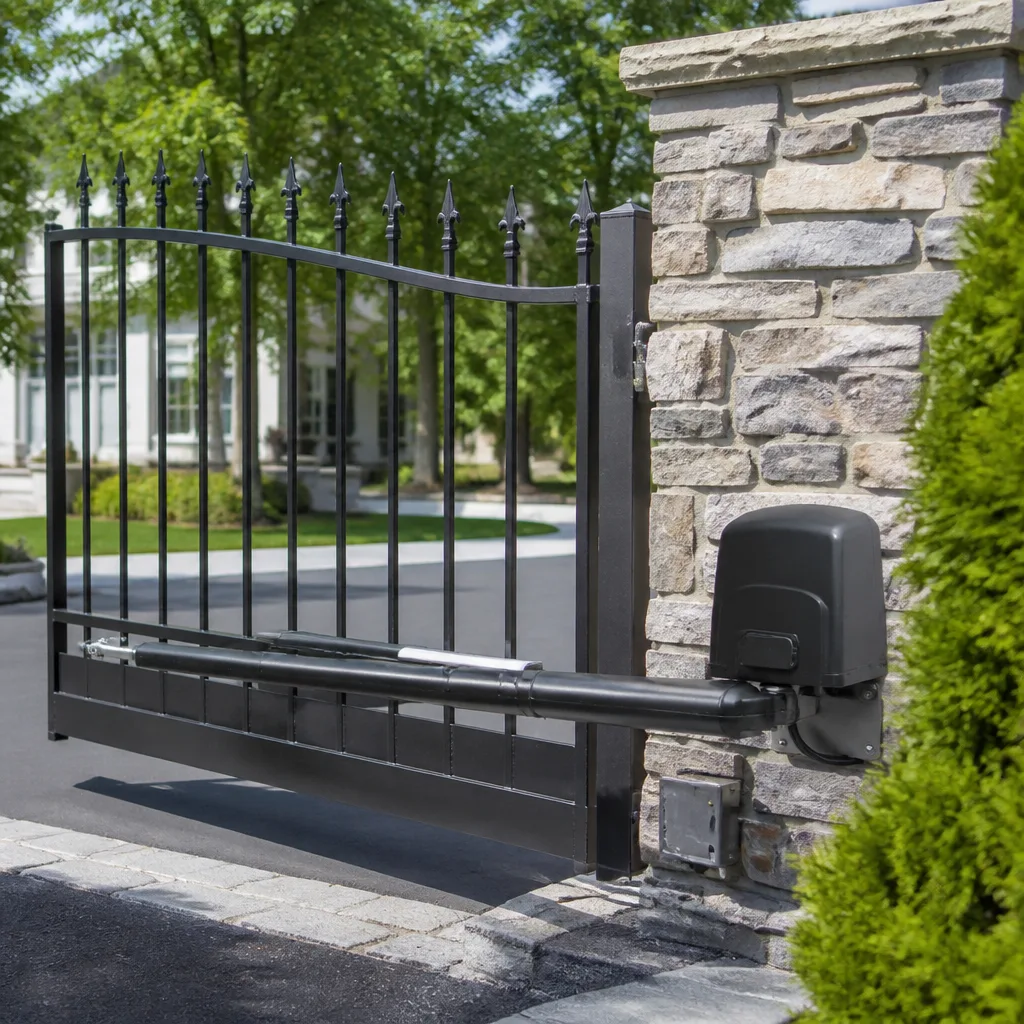
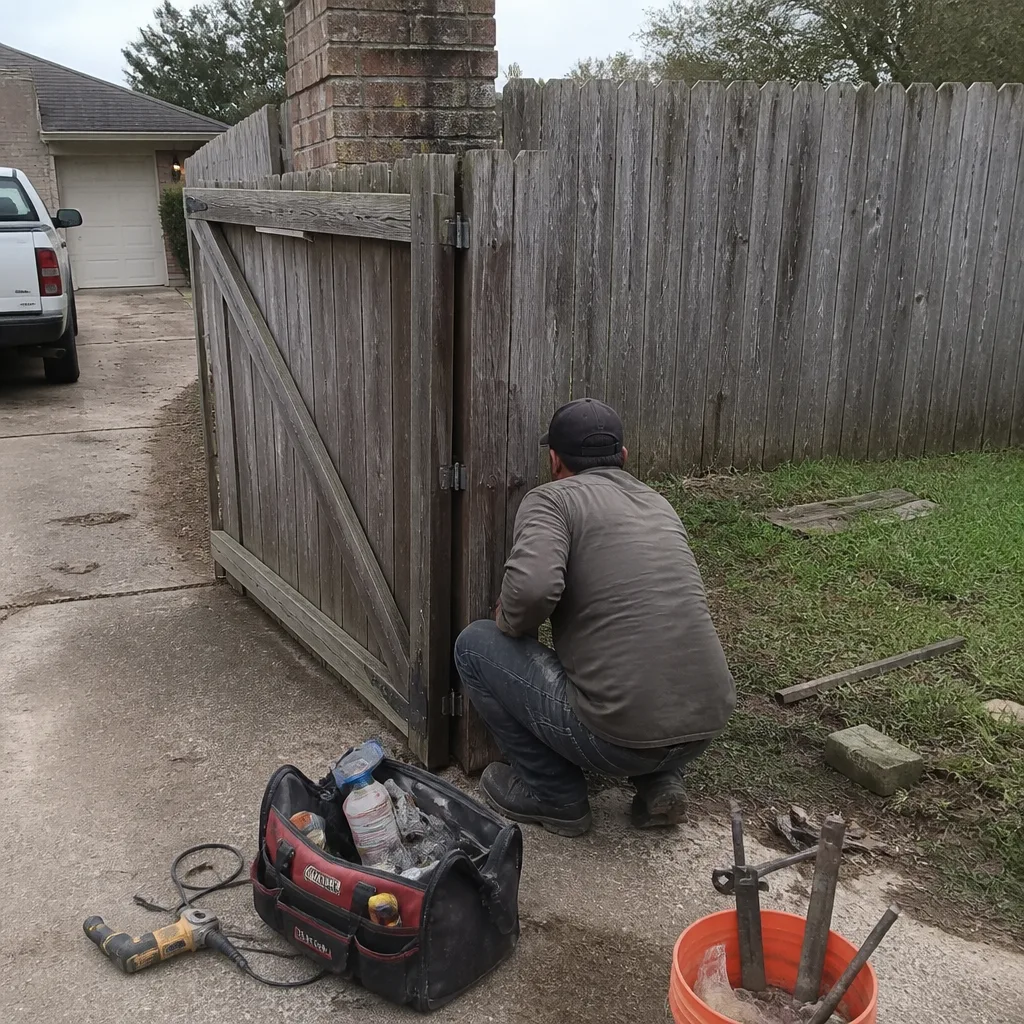 Before
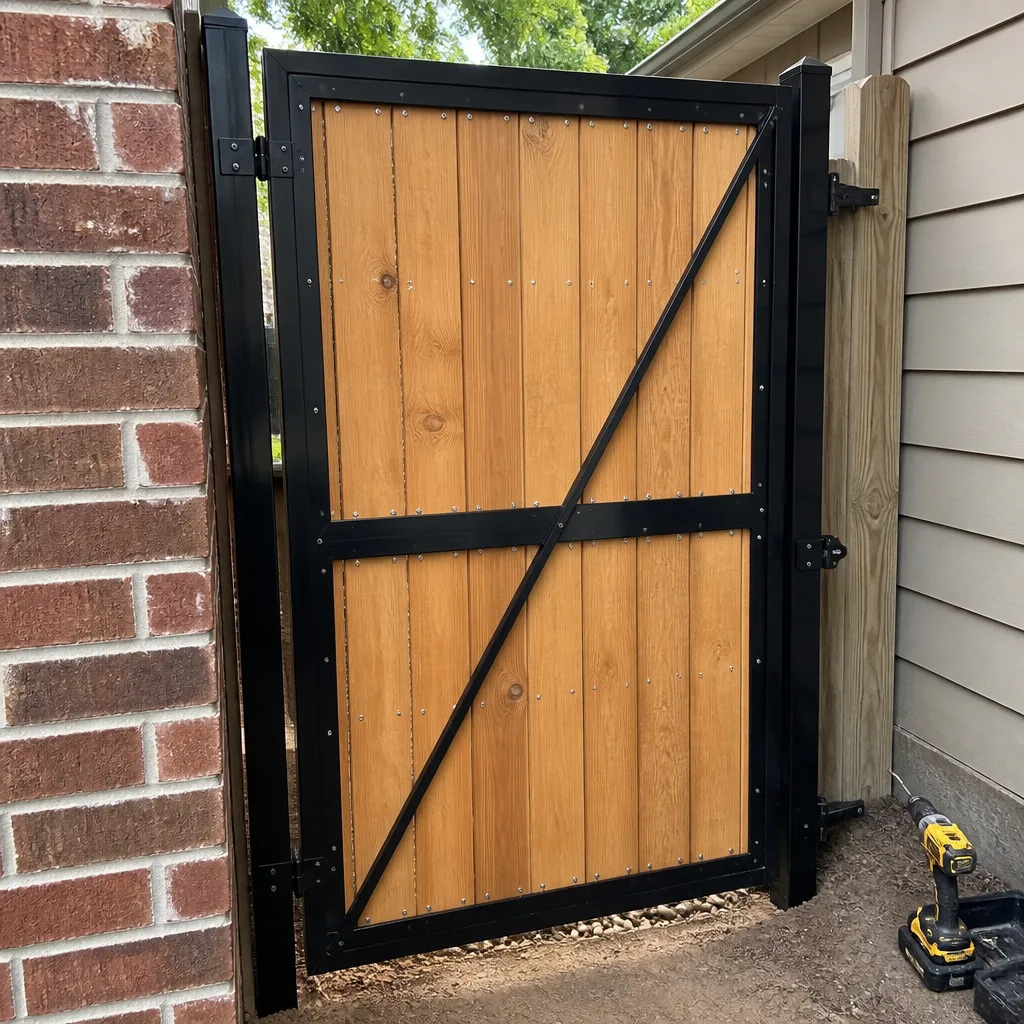 After
After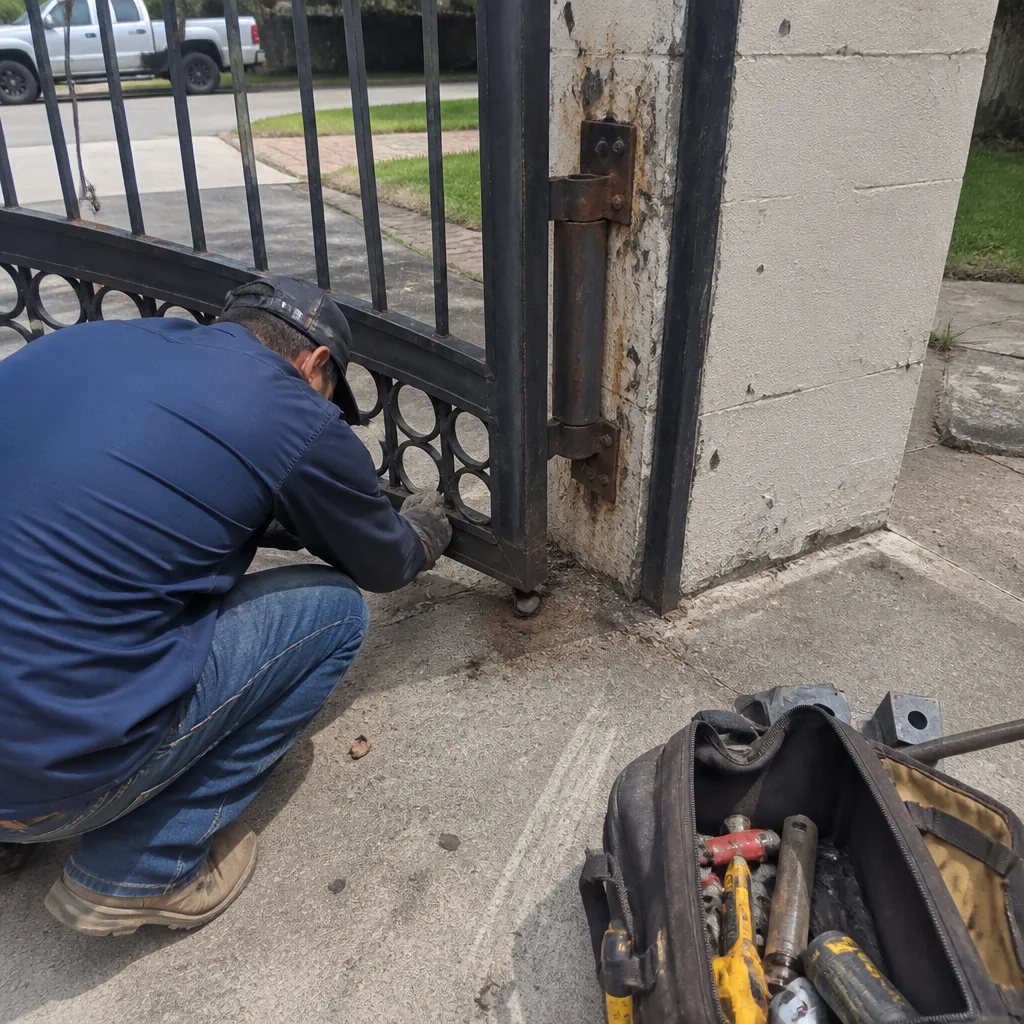 Before
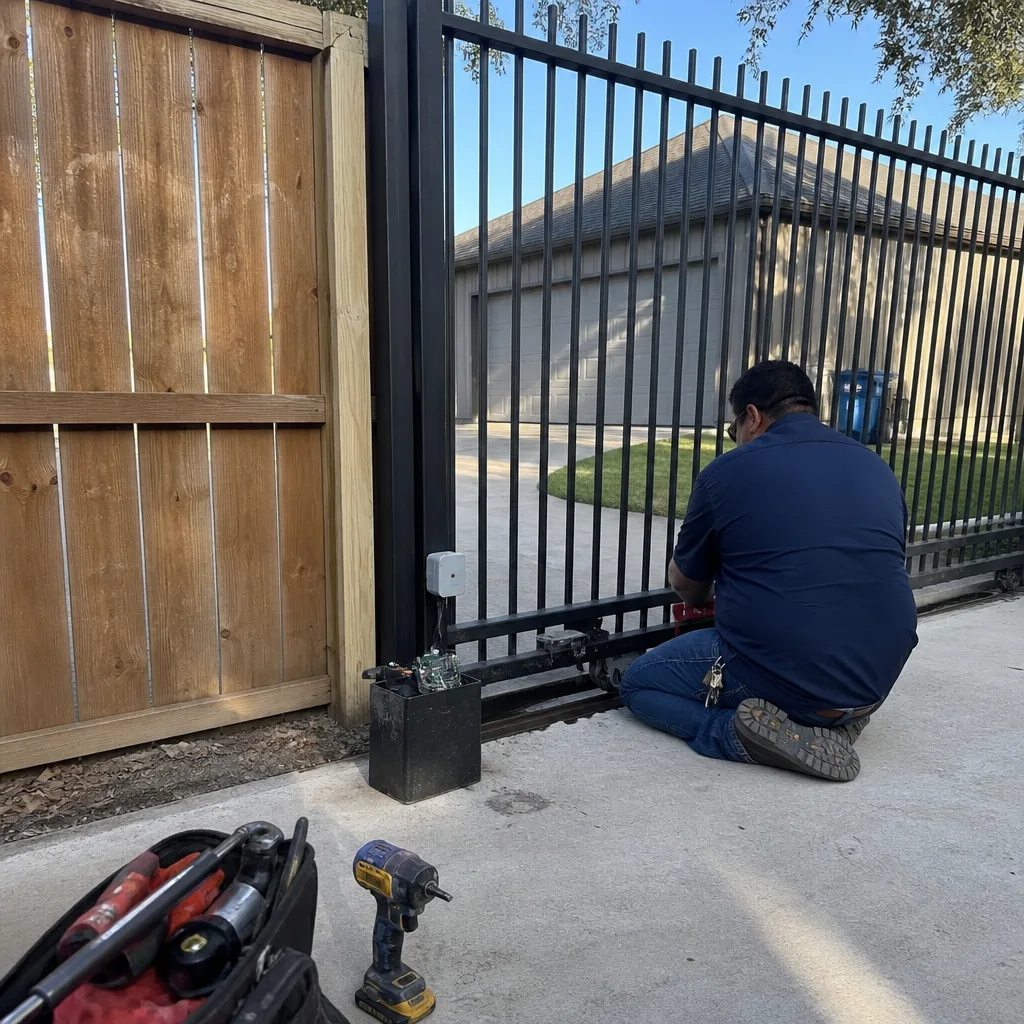 After
After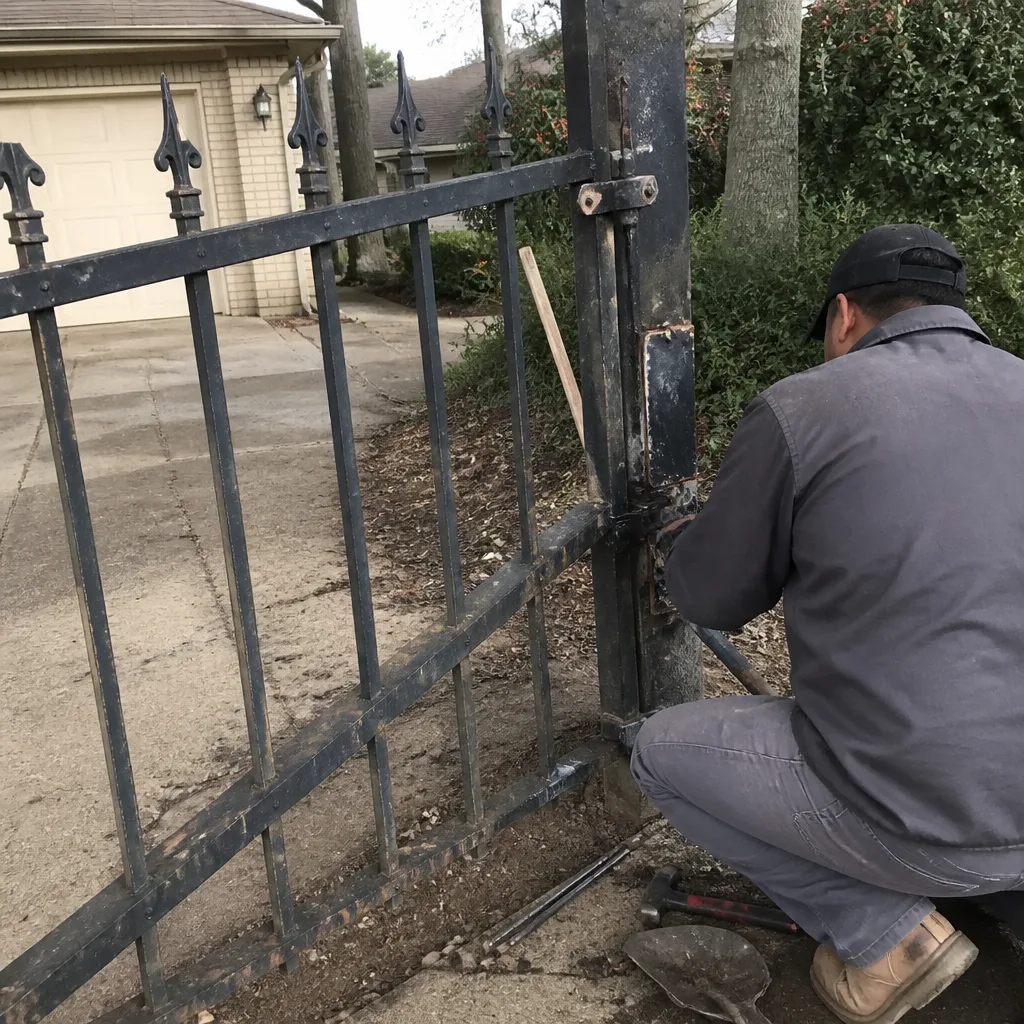 Before
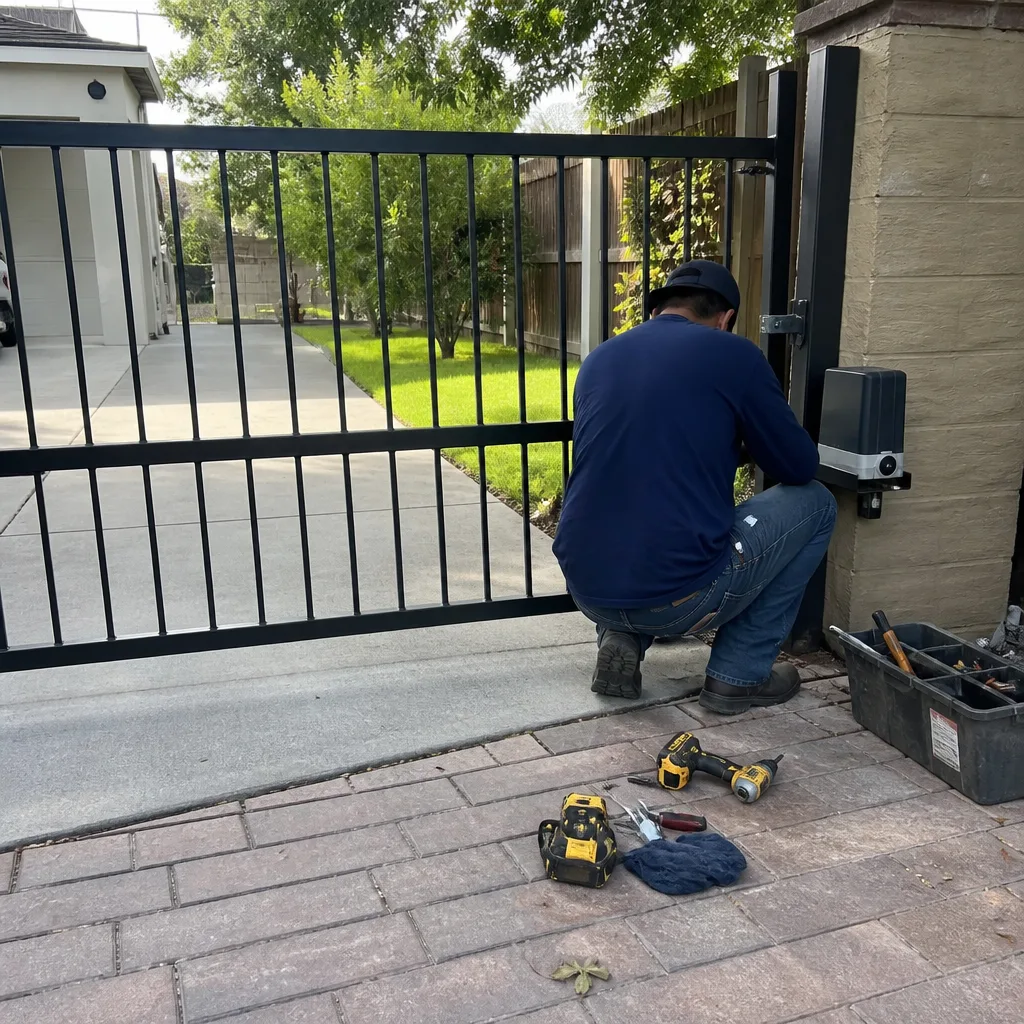 After
AfterHow to Hire a Gate Repair Contractor in Katy: A Step-by-Step Guide
Walk through any Katy neighborhood with automatic driveway gates and you’ll see the same story on half the callbacks we run: a motor that worked for three weeks after a “repair,” then failed again because the technician never wrote down what he changed. The gate repair trade has a documentation problem. Not a skill problem. A paper-trail problem. The best contractors carry cameras and notebooks. The rest carry a multimeter and a verbal estimate, and in Katy, where humidity corrodes limit switches and lightning poisons control boards, the difference between those two operators is the difference between a one-time fix and a gate you reset with a broom handle every March. This guide gives you a filter built from what separates the two: documents to demand before you sign, questions that expose whether anyone actually diagnosed the gate, and a framework for comparing bids that look nothing alike. For more detail, see our Complete Guide to Gate Repair in Katy.like on paper.
Quick Answer
To hire a gate repair contractor in Katy, require three documents before any work begins: a written scope of work, a written price, and a description of what documentation you’ll receive after the repair. Verify that the contractor services your gate’s automation brand, ask diagnosis questions that prove they plan to inspect the gate rather than quote from your symptom description, and compare normalized bids using labor hours and brand-name parts, not bottom-line totals. A live person should answer when you call.
Table of Contents
- The Three Documents to Require Before Signing Anything
- Questions That Reveal Whether the Contractor Diagnosed the Gate
- What a First Visit in Katy Should Look Like
- How to Compare Bids When the Scopes Are Written Differently
- Red Flags Specific to Gate Repair in Katy
- Why Katy’s Humidity and Storms Change What You Should Ask
- Common Mistakes to Avoid
- When to Call a Professional
- Frequently Asked Questions
- The Bottom Line
BeforeAfterThe Three Documents to Require Before Signing Anything
Most gate repair contractors in Katy operate on a handshake and a verbal number. That’s the industry default, and it’s also the reason homeowners end up in disputes they can’t win. A verbal estimate leaves no record of what was promised, what was excluded, or what the technician actually did when he opened the control box. The fix is simple and it costs you nothing: require paper before the wrench. Here are the three documents that separate a documented operator from a drive-by quote.
1. The Written Scope of Work
The scope is a plain-language description of what will be done, where, and with which parts. It should name the gate’s location on your property, the specific job being performed, and every component involved. A legitimate scope for a swing gate motor replacement in Katy reads something like: “Remove failed Linear actuator arm; install new Linear LRA replacement arm; retain existing mounting bracket; verify limit switch positions; test full open-close cycle five times.” That’s a scope. What it is not: “Fix gate motor” with a price next to it. If the contractor won’t write a scope, you’re hiring a metaphor, not a repair.
2. The Written Price
Written price means a dollar figure on paper before anyone picks up a tool. Not a range offered over the phone. Not a “we’ll see when we get there.” A firm number, with parts and labor separated so you can see what you’re paying for each. Vance Gate Repair services operate under a documented standard on this point: the flat price is written and handed over before any work starts. That single practice eliminates surprise invoices, scope creep, and the “we found another problem” upcharge that plagues this trade. If a contractor won’t write the price down, assume the price is still moving.
3. The Leave-Behind Documentation Description
Ask this question before hiring: “What am I left with after you’re done?” Most homeowners don’t ask, and they’re left with a receipt that says “gate repair $400.” The answer you want is a documented record of what was found, what was adjusted, and what was installed. A photo log of the control board before and after. The position of the limit switches. A part number. We leave every customer with exactly that: a written record and photographs of what we found and what we changed. That record matters more in the second year than in the first, because when a different technician opens your gate, he should be able to see what was done without guessing. Guessing is how you pay for the same diagnosis twice.
These three documents cost the contractor ten minutes. They save you from every vague labor line item and every surprise invoice that gate repair in Katy has ever produced. If a contractor resists any of the three, you’re not negotiating. You’re being told how the project will end.
For a deeper look at how a documented repair process works in practice on the most common gate failures, see our Gate Repair in Katy page.
Questions That Reveal Whether the Contractor Diagnosed the Gate
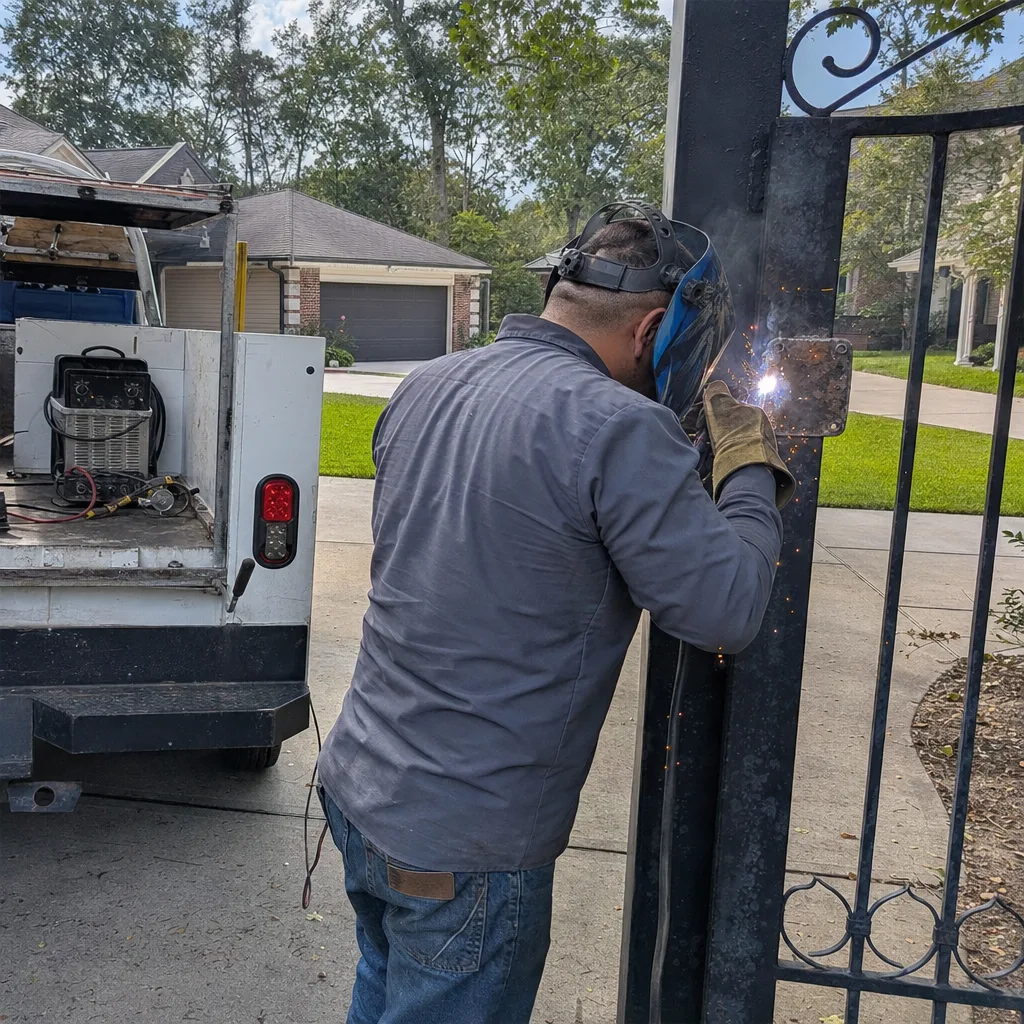
The difference between a gate repair contractor who diagnoses and one who quotes from a script is measurable, and it shows up in the first five minutes of a phone call. A diagnosing contractor asks about your gate. A quoting contractor tells you what it probably is. Here are the questions you should ask, and the answers that reveal which one you’re talking to.
“What brands do you service?”
Katy has gates running every automation brand sold in the last twenty years. Linear, Viking, Ghost Controls, DoorKing, LiftMaster, FAAC, BFT, Elite, Mighty Mule. A contractor who says “we do everything” hasn’t told you anything. Ask specifically: “Do you work on Linear actuators?” or “Have you serviced a DoorKing control board this month?” A specialist will answer with specifics, like how a Viking arm’s limit switch behaves differently from a Ghost Controls setup, or which DoorKing board revisions have known capacitor failures in Houston-area humidity. If the contractor can’t name a brand behavior, he’s planning to learn on your gate.
“You haven’t seen my gate yet. How are you quoting me?”
This is the single most revealing question in gate repair. A contractor who gives a firm price over the phone before seeing the gate is quoting from a menu, not from a diagnosis. Gate failures have causes. A motor that won’t respond could be a dead capacitor, a fried control board, a misaligned limit switch, a broken wire at the hinge, or a failed photo-eye. None of those is identifiable from “it stopped working.” A legitimate contractor will say some version of: “I need to see the gate, open the control box, and test the components before I can give you a real number.” If they give you a real number over the phone anyway, ask what’s included when the cause turns out to be something else.
“Will you document what you find?”
This is where the documenting operators separate from everyone else. Ask whether the technician will take photos and leave a written record. Every repair we perform includes a documented photo record: what we found, what we adjusted, what part number we installed. That habit came out of commercial access-control work, where a control panel without documentation is a liability. We brought the same standard to residential gates in Katy. If a contractor says documentation isn’t part of the job, he’s telling you the job ends when he leaves, not when your gate keeps working.
“What’s your process if the repair fails?”
The answer that separates a professional from a drop-in operator is specific and time-bound. Our standard is one year, no argument, no fee, no expiration date within that window: if the repair is not right, we make it right. That’s our 365-Day Done Right Promise. Most contractors will answer in vague terms: “we stand behind our work,” “most of the time it holds up.” “Most of the time” is a warranty from someone who expects failures. Ask for the exact window and the exact terms.
None of these questions is aggressive. They are the difference between hiring someone who looked at your gate and someone who estimated your gate from the other side of the phone. In Katy, where a gate will cycle through hundred-degree summers and tropical downpours in the same week, diagnosis is the only thing standing between you and a repair that lasts one season.
What a First Visit in Katy Should Look Like
You’ve booked the appointment. Now here’s what separates a proper first visit from the kind that generates our callbacks. This is what we tell Katy homeowners to expect, and what we deliver on every visit we make.
Time and Access
A real diagnosis on an automatic gate takes between 45 minutes and two hours. Less than that, and the technician didn’t test everything. Longer than that, and he might be learning on the job or padding the clock. The technician will need access to the control box, which is usually mounted near the motor or on a post near the gate. If the gate won’t open at all, there’s usually a manual release key or handle. It helps to know where that release is before the technician arrives, but a competent tech will find it in about two minutes without you. He should also test the gate through at least four or five complete cycles: open, close, mid-cycle stop, photo-eye interruption.
What the Technician Should Do
Here is the sequence a trained gate technician in Katy goes through, and what watching it should tell you. First, he checks the obvious: power to the control board. Half of the “dead gate” calls in Katy turn out to be a tripped GFCI outlet or a breaker. If a technician skips this and starts disassembling the motor, he’s not testing. He’s performing. Second, he opens the control board and looks for what the environment left behind: corrosion on the terminals, blackening around the relays, the sign of a lightning surge that entered through the low-voltage line. Third, he tests each component in sequence, from the power supply to the board, to the limit switches, to the motor itself. The test order matters. You cannot diagnose the motor until you’ve ruled out the board, and you cannot diagnose the board until you’ve confirmed power. A tech who tests out of order is guessing with tools.
What You Should Receive Before the Technician Leaves
Before the technician leaves, regardless of whether you approve the repair that day, you should receive: a written description of what he found, a written price if the repair can be quoted on the spot, and the photographic evidence of what he saw. We leave every customer with a photo log of every adjustment and a written record of the part number installed. That record costs us nothing and it saves every future technician on that gate a complete re-diagnosis. It is the single most valuable thing a gate repair professional can leave behind, and the thing most of them never do.
The Shortcut Signals
Now the shortcuts that signal a low-documentation operator. Technician shows up without a camera or phone. That alone is not a firing offense, but combined with a missing notepad it tells you everything. Technician quotes only from your description and never opens the control box. In Houston-area humidity, a control box can tell you the gate’s entire medical history: water stains, insect nests, corroded grounds. A technician who doesn’t open it isn’t looking for history, he’s looking for a reason to sell you a motor. Technician gives a verbal estimate but no paperwork. We’ve said it once and we’ll say it because it’s the whole point: a verbal estimate is a moving estimate. In Katy’s gate repair market, the operators who avoid paper are the ones who need to.
If you’re considering a full replacement rather than a repair, our Gate Installation in Katy page describes what a documented installation process should include.
How to Compare Bids When the Scopes Are Written Differently
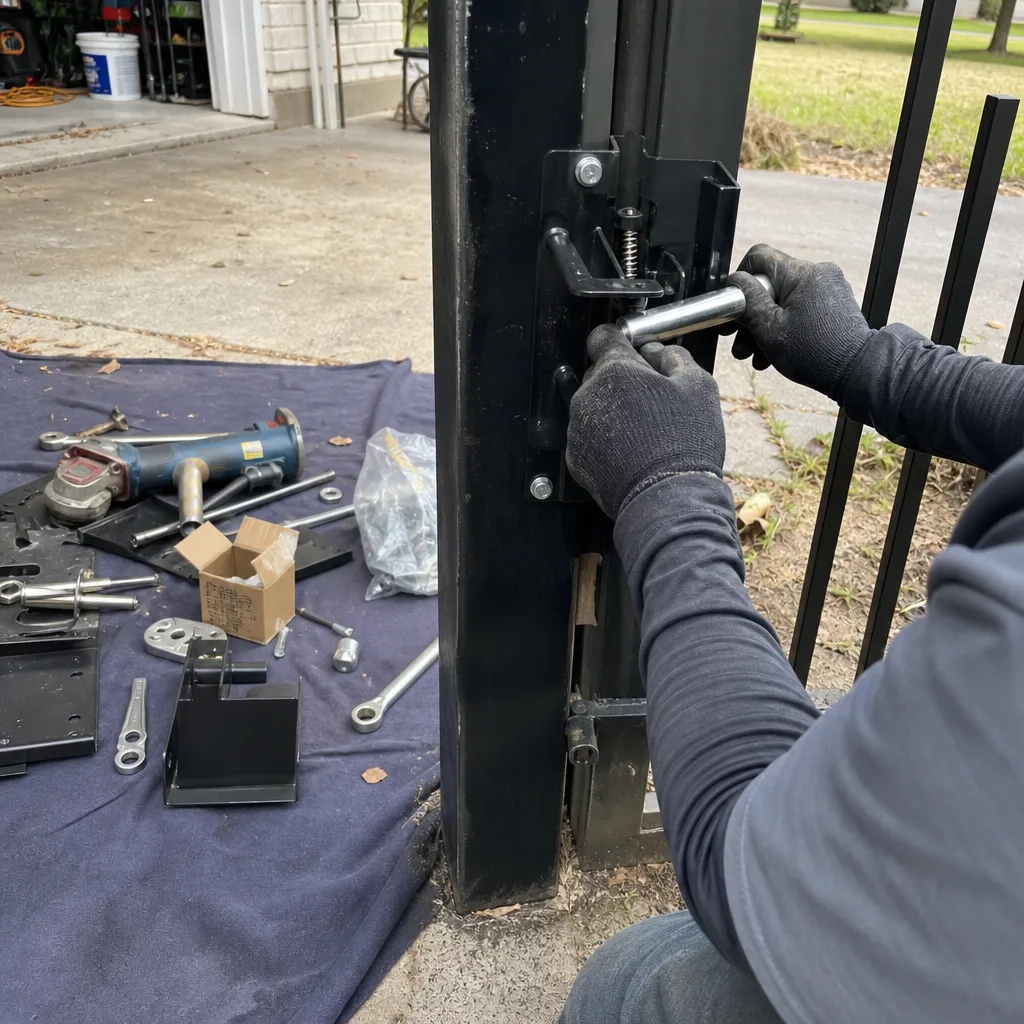
Two bids on your kitchen table. One says “gate repair $350.” The other says “Replace control board, DoorKing 8080, test photo-eye, lubricate hinges, $520.” Which one is cheaper? The first one, until the motor fails next month and you learn the control board was never the problem. Comparing gate repair bids in Katy is an exercise in normalization. You are not comparing prices. You are comparing documented scopes, and when the scopes are written differently, you need a method.
Step 1: Strip Labor from Parts
Every legitimate gate repair bid has two components: parts and labor. If a bid doesn’t separate them, it’s a signal the contractor doesn’t want you to see the ratio. Write down the two numbers for each bid. Now ask: does the labor figure include diagnosis time already spent, or is that billed separately? Was the travel charge absorbed into labor, or is it a line item? In Katy, a contractor driving from the other side of Houston has a different overhead than one who dispatches from a shop ten minutes away. That difference shows up in the labor number, and it should. What you’re watching for is a labor figure with no explanation and no breakdown.
Step 2: Name the Parts by Brand and Part Number
“Control board” is not a part. “DoorKing 8080 control board, revision C” is a part. “Actuator arm” is not a part. “Linear LRA actuator arm, 24-inch stroke” is a part. The repair bid that names parts by brand and number is the bid from someone who has called the supplier and confirmed the price. The bid that says “replacement motor unit” is a placeholder for whatever the tech picks up at the supply counter on the way to your house. Ask each contractor to re-quote with exact part numbers. The one who can’t is about to learn what your gate needs from the box the part comes in.
Step 3: Ask What “Testing” Means in the Scope
Every repair scope should end with some version of “tested.” But tested how? Tested with the gate cycled five times? Tested with the photo-eye interrupted mid-cycle? Tested with the manual release pulled? The test protocol tells you how the contractor defines done. Our standard at Vance Gate Repair is five full open-close cycles, plus one interruption test of the photo-eye, plus verification that the limit switch is set to stop the gate before it hits the mechanical stop. That’s what “tested” means in our scopes, and it’s what you should ask any contractor to define in writing.
Step 4: Normalize the Warranty
One bid includes a 30-day “we’ll come back if it fails” promise. Another includes a one-year written guarantee. To compare these, turn them into dollars: ask the contractor with the thinner warranty what he’d charge to extend it to a year. If he won’t, ask why. In our experience, the contractor who won’t put a year on his work knows something about his work. We put 365 days on every repair we complete. It’s not a marketing line. It’s a line item in the written scope.
Step 5: Check the Documentation Promise
Finally, compare the documentation promise. Contractor A says he’ll text a photo of the finished job. Contractor B says you’ll receive a written record of what was found, what was adjusted, and what part number was installed, with photos of the control board before and after. One of these is a doorbell camera. The other is a service record. In Katy, where a gate may outlast the contractor who repaired it, the service record is the more valuable deliverable, and it doesn’t appear on the invoice as a line item because it’s part of the professional standard.
The normalized comparison is: documented labor cost per hour, named parts by brand and number, a defined test protocol, a time-bound warranty, and a documentation deliverable. Line those five up across any three bids and the “cheapest” one usually stops looking cheap. Which is exactly the point of the method.
For information on how gate motors and openers factor into repair scopes and pricing, see our Gate Motor & Opener in Katy page.
Red Flags Specific to Gate Repair in Katy
Every trade has its red flags, and gate repair has more than most because the barrier to entry is low and the visibility into what a technician actually did is near zero. A driveway gate is a machine with moving parts, electrical controls, and safety systems. The red flags below are the ones we see most often in Katy, the ones that generate our callbacks, and the ones that should make you end a call or cancel a visit.
Quoting by Phone Without Seeing the Gate
The most common red flag, and the easiest to spot. A contractor who gives a firm price over the phone before looking at the gate is quoting from a symptom script. “Won’t open? That’s usually the board, $450.” It’s not the board. It’s the power supply, or the limit switch, or a wire broken inside the hinge. Or it is the board. The point is he doesn’t know, because he hasn’t opened the control box. Any price quoted before inspection is a placeholder designed to get a technician on your property, where the upselling starts.
No Mention of Control Board Brand Compatibility
When a gate’s electronics fail, the fix almost always involves a control board or a component on one. Here is what a professional asks before quoting a board: what brand is the gate automation, what model is the board, and what revision is it. Because boards change revisions, and revisions change compatibility. A DoorKing board from 2018 is not compatible with every DoorKing motor from 2018. If the contractor says “I’ll just put a universal board in,” understand what that means: a generic board wired into an existing motor, with limit switches reconfigured and safety systems potentially bypassed. Universal boards have their place. Proposing one before seeing the existing board doesn’t.
Vague Labor Line Items
“Labor: 4 hours.” What were the four hours spent doing? Diagnosing? Removing? Installing? Testing? Labor should be described with the same specificity as parts. “Two hours diagnosis and testing; 90 minutes board replacement and wiring; 30 minutes cycle testing and adjustment.” That’s a labor description. If a contractor can’t tell you what his labor line item covers, he’s not hiding the complexity. He’s hiding the padding.
Pushing a Full Replacement Before Diagnosing the Existing Equipment
Some gates in Katy are at the end of their service life and should be replaced. A 20-year-old swing gate with a rusted frame and a motor that’s been struck by lightning twice might be a replacement job. But that’s a diagnosis. It’s not a default. The contractor who arrives, opens nothing, taps the motor once, and announces “she’s done, you need a new gate” is selling you his highest-margin product, not his best advice. We service nine major automation brands because our job is to fix what’s on the property when it can be fixed, not steer every repair into an installation. The gate motor industry sometimes treats repair as a lost sales opportunity. It’s a philosophy. And it’s a red flag.
No Safety System Verification
Every automatic gate in Katy has at least one safety system: a photo-eye, a safety edge, or both, depending on the gate’s size and the installer’s original scope. A professional repair includes verification that these systems still function after the work is done. A contractor who never mentions the photo-eye, or waves off a question about safety edges, is either ignorant of the system or planning to leave it disconnected. Both are unacceptable. A gate that closes on a car, or worse, has a safety system for a reason, and the contractor who doesn’t test it isn’t completing the job.
The One-Man Band With No Documentation Habit
A solo technician who is excellent at gates can do outstanding work. But if he doesn’t write anything down and doesn’t take photos, the quality of his work dies with his memory. The test is simple: ask him what record you’ll have of what he did. If the answer is “my word,” that’s a red flag. Not because he’s dishonest, but because six months later, when something else fails on the gate, neither he nor anyone else will remember exactly what he touched, and a new diagnosis will start from zero, and you will pay for that diagnosis again. Documentation is not bureaucracy. It’s the most practical thing a gate repair contractor does, and the thing that separates a professional from a craftsman with a truck.
Why Katy’s Humidity and Storms Change What You Should Ask
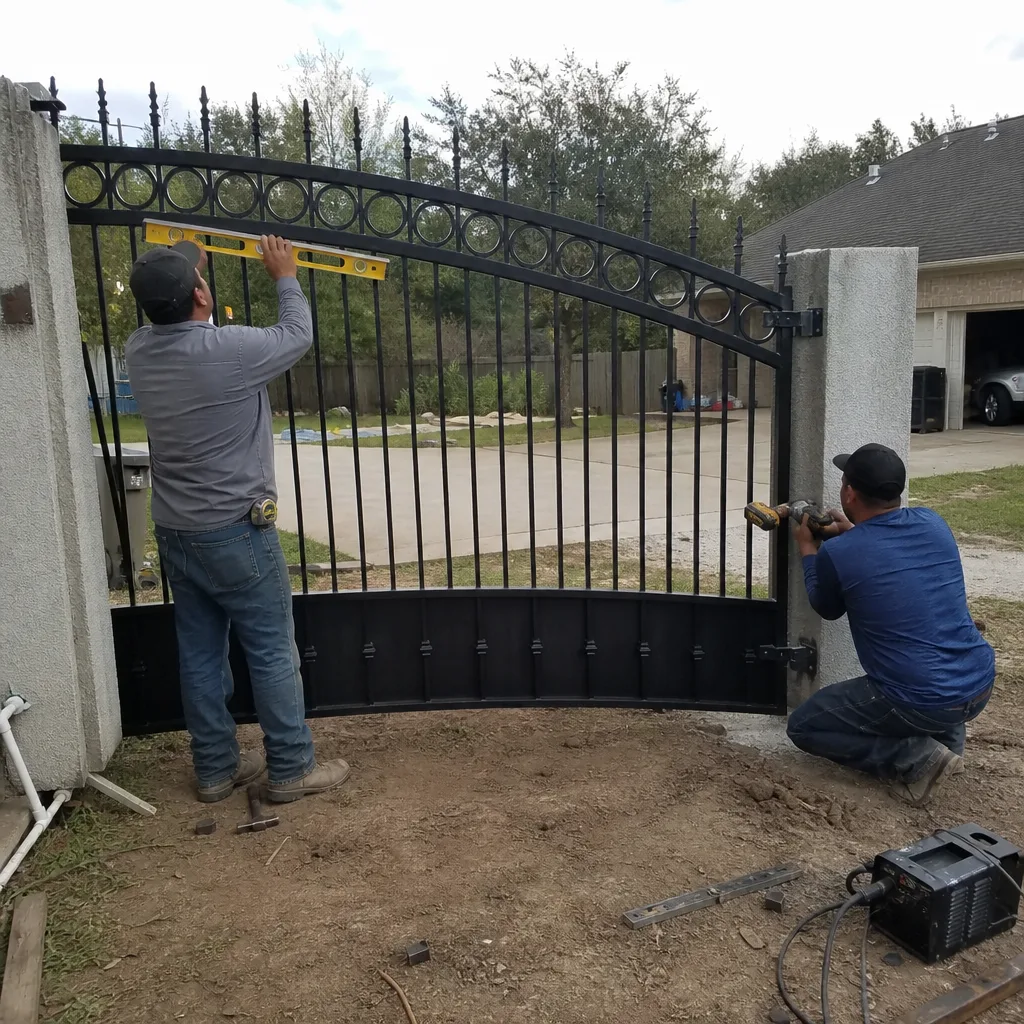
Katy’s climate is not a footnote to gate repair. It’s the engine that drives most of it. The combination of Gulf Coast humidity, 90-degree summer averages, and the lightning that comes with late-summer thunderstorms means gate components in Katy fail differently than they do in, say, Dallas or Austin. If you’re hiring a gate repair contractor here, the local climate should change your questions.
Humidity and Corrosion
Driveway gates in Katy live outdoors year-round, and the air is wet. Control boards corrode. Terminal blocks grow green oxidation. Hinges seize. The limit switches mounted on the gate’s travel path are exposed to condensate every morning. When a gate works fine in winter and starts acting erratically in July, that’s often a corrosion issue that has finally breached a connection. Ask your contractor how humidity is factored into his diagnostic process. A contractor who has worked only in dry climates won’t look for corrosion first, and in Katy, corrosion is usually first.
Lightning and Surge Damage
Spring and summer storms in the Houston area produce ground-to-cloud lightning that enters gate systems through two pathways: the low-voltage line controlling the gate from the house, and the power line running from the outlet or breaker to the motor. The resulting surge doesn’t always kill a gate instantly. It can weaken a control board’s relays, and two months later the board fails for “no reason.” When we diagnose a dead board in July, we ask when the last big storm was. A contractor who’s new to Katy won’t ask that question. One who’s been here a while will, because he’s replaced enough storm-damaged boards to know the pattern: lightning weakens the component, humidity finishes it.
Heat and Motor Duty Cycles
An automatic gate motor in Katy cycles through 95-degree heat for four months of the year, and the heat accelerates wear on every component with a coil or a capacitor. If your gate is opening and closing ten times a day through a Katy summer, that’s a heavy-duty cycle on a residential-grade motor. Ask whether the contractor is quoting a motor rated for your actual duty cycle. A motor rated for light use will fail in two Katy summers. A motor rated for continuous or heavy use will run for a decade. The price difference between the two is not a markup. It’s a rating difference.
The climate-specific questions to ask: “Have you seen this exact failure on other Katy gates this season?” and “What’s the most common weather-related cause you’d check first?” If the answer is a specific component with a specific weather cause, you’re talking to someone who’s learned the local failure patterns. If the answer is a general “well, weather wears on these over time,” you’re talking to someone reading from a national script.
Common Mistakes to Avoid
- Hiring on speed alone. “Can you come tomorrow?” is a reasonable question in an emergency, but speed doesn’t equal competence. The fastest responder in Katy is often the contractor with no backlog because no one re-hires him. Ask about availability, but weigh it against the three documents.
- Accepting a verbal estimate. We have made this point repeatedly because it is the single most common mistake Katy homeowners make. A verbal estimate is a range, and ranges expand. Get the price in writing before the work starts.
- Comparing bids by total price. The bottom line hides everything that matters: whether the parts are brand name or off-brand, whether testing is included, whether the warranty is 30 days or a year. Normalize the scopes before you compare the totals.
- Not asking what documentation you’ll receive. The repair record is free to produce and priceless to own. If you don’t ask for it, you won’t get it, and the next technician on your gate will charge you to re-learn everything the previous technician already found.
- Assuming the gate motor is the problem. In Katy, a gate that won’t open is more often a power supply issue, a blown fuse, or a photo-eye out of alignment, than a failed motor. The motor is the most expensive component, so it’s the one that gets blamed by contractors who don’t test. Insist on a diagnosis, not an assumption.
- Skipping the safety system check. After any repair, the photo-eye and any safety edges should be tested. A gate that closes when it shouldn’t is a liability on your property. The contractor who skips this test is leaving a hazard behind, and you’re the one who owns it.
- Choosing a contractor who doesn’t know your brand. Ghost Controls and Viking and Linear all have different control logic, different limit switch behavior, and different fail modes. The contractor who’s “sure he can figure it out” on your specific brand is telling you he’ll practice on your gate.
When to Call a Professional
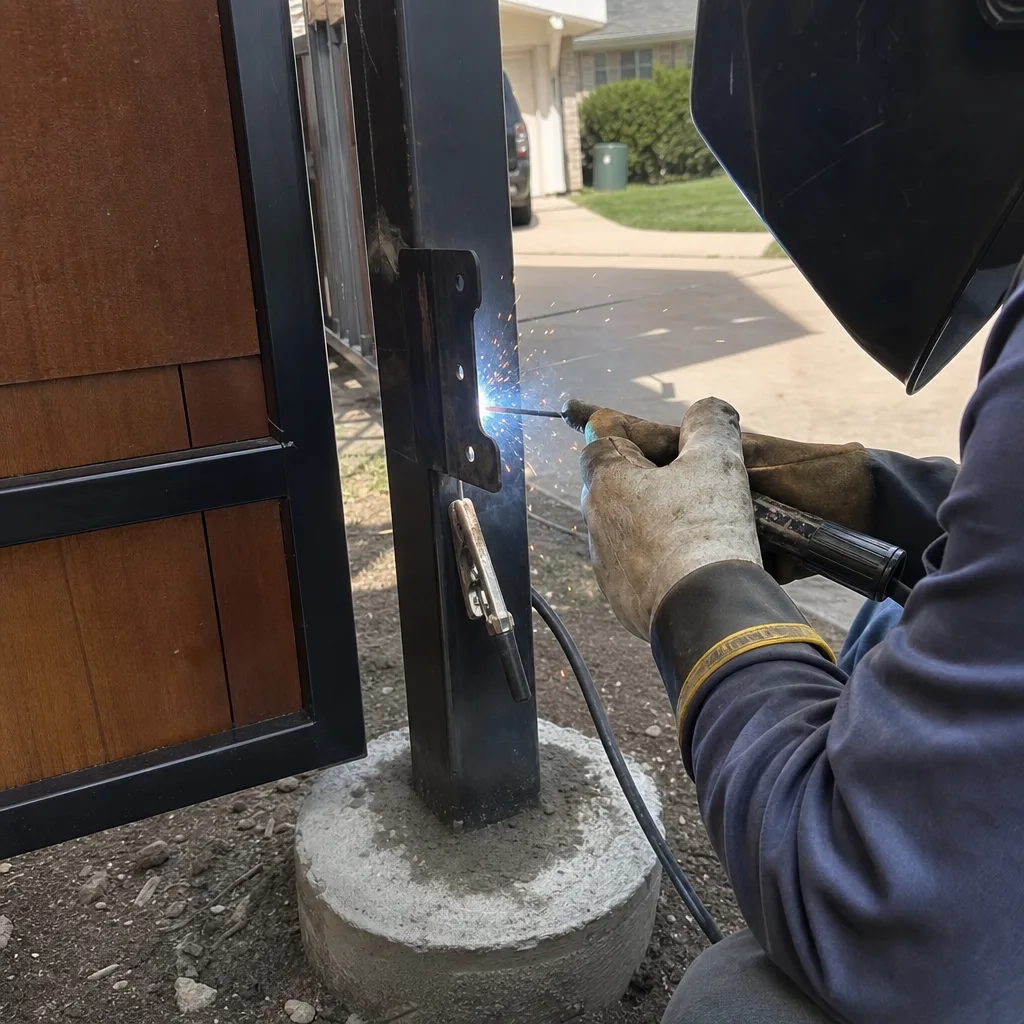
You can clean your gate’s photo-eye lenses, and you can check a tripped GFCI outlet. Those are homeowner tasks. Everything else moves into a professional’s territory quickly. Call a gate repair professional in Katy when the gate stops mid-cycle and won’t self-correct, when the motor runs but the gate doesn’t move, when the gate reverses immediately after closing, when the control board shows scorching or smells like burnt plastic, or when the gate has taken any impact from a vehicle. Automatic gates have high-tension springs, heavy moving panels, and live electrical components. They are not a place for guesswork, especially for anyone without training in low-voltage and line-voltage systems. For more guides & resources, visit our blog. Vance Gate Repair Katy offers free estimates in Katy, and a live person answers the phone at (346) 818-3319 any hour. We’ll send a documented technician, not a verbal estimate.
Frequently Asked Questions
Most gate repairs in Katy run between $180 and $650, depending on what failed. A photo-eye replacement typically lands between $120 and $250, a limit switch adjustment between $90 and $180, and a control board replacement between $300 and $650 depending on brand. Motor replacements range from $450 to $1,200. The price depends on the diagnosis, and the diagnosis requires opening the control box. Get the price in writing after the inspection, not before. Call (346) 818-3319 for an exact quote on your gate, and we’ll put the number in writing before we start.
In Katy, yes. A live person answers our phone 24 hours a day, seven days a week, and emergency same-day dispatch is available for gates that won’t close or won’t open and are blocking a vehicle. Same-day scheduling depends on your location in Katy and the technician’s route, so call (346) 818-3319 and we’ll give you a straight answer, not a callback window.
We service nine major gate-automation brands: LiftMaster, FAAC, BFT, Linear, Viking, Ghost Controls, DoorKing, Elite, and Mighty Mule. Whatever motor is already on your Katy property, we work on it. We don’t steer repairs toward a replacement brand we happen to sell. We fix what’s there when it can be fixed.
You’ll need to be home for the initial diagnosis, because the technician needs access to the control box, the gate’s manual release, and any power outlets or breakers in the garage and exterior. Once the diagnosis is done and the written price is approved, most repairs can be completed the same visit. The whole process takes under two hours in most cases.
Look for a specific, time-bound written warranty on both parts and labor, not a verbal assurance. Our standard is one year on every repair we complete, with no fee and no argument if the repair is not right within that window. Ask any contractor how long their work is covered in writing, and what triggers the coverage. A good answer includes the specific number of days and the specific conditions.
You should receive a written record of what was found, what was adjusted, and what part number was installed, plus photographs of the control board and any replaced components. At Vance Gate Repair, that photo log and written record is included on every visit at no additional charge. It’s your service history for the gate, and it saves you from paying to re-diagnose the same problem later. Call (346) 818-3319 to schedule a visit, and ask for the documentation. We’ll hand it to you before we leave.
The Bottom Line
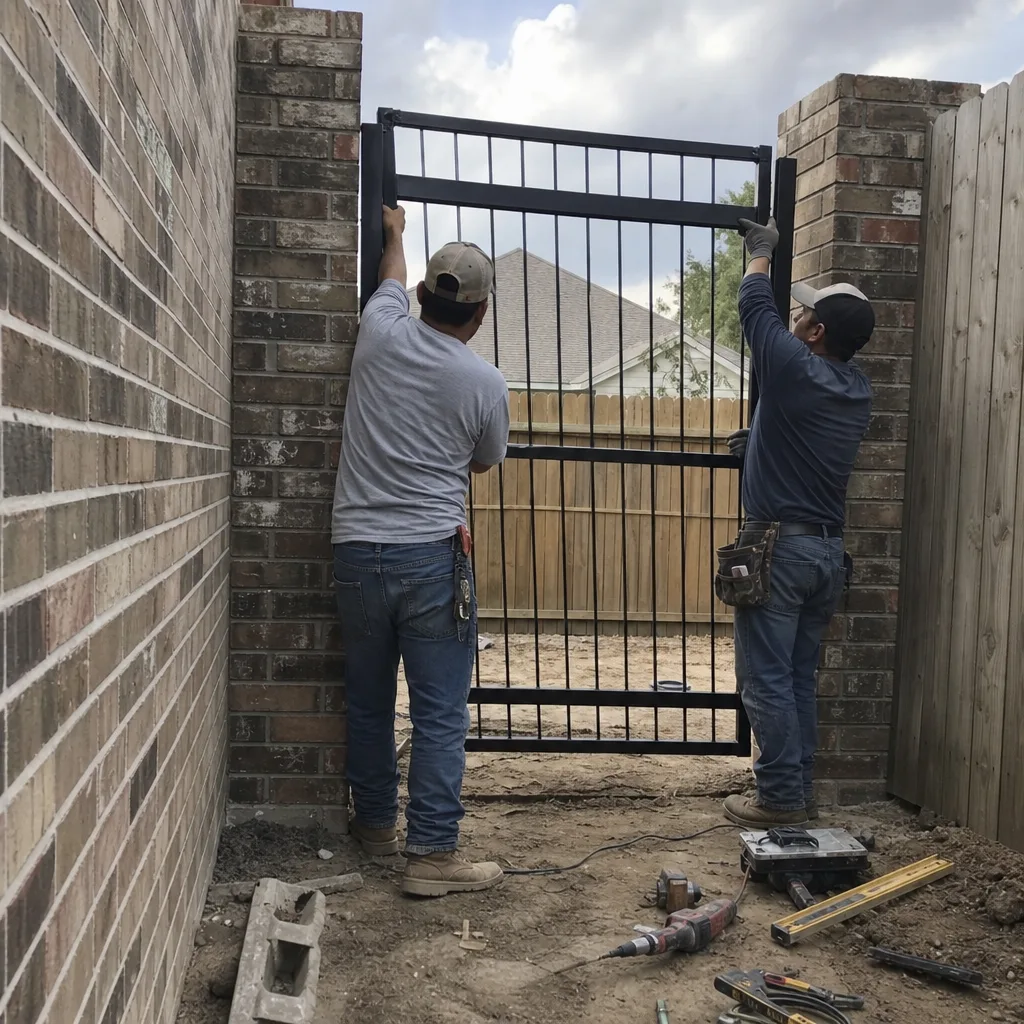
Hiring a gate repair contractor in Katy is not about credentials or review scores. It’s about documents. Three of them: a written scope, a written price, and a leave-behind record. If you require those three before any work begins, you filter out the low-accountability operators faster than any review site can. Ask diagnosis questions that force the contractor to talk about your gate, not his menu. Normalize bids by parts, labor, testing protocols, and warranty terms before comparing totals. Watch for the red flags of phone quoting, vague labor lines, and brand-blindness. And remember the climate: Katy’s humidity, lightning, and heat are half the diagnosis. The contractor who knows that is the one you want. Vance Gate Repair Katy home is one qualified call away, and we’ll put the price in writing before anyone picks up a tool.
Written by Adrian Vance, Owner at Vance Gate Repair Katy, serving Katy since 2014.